Spiritual Practice as Maintenance, Not Performance
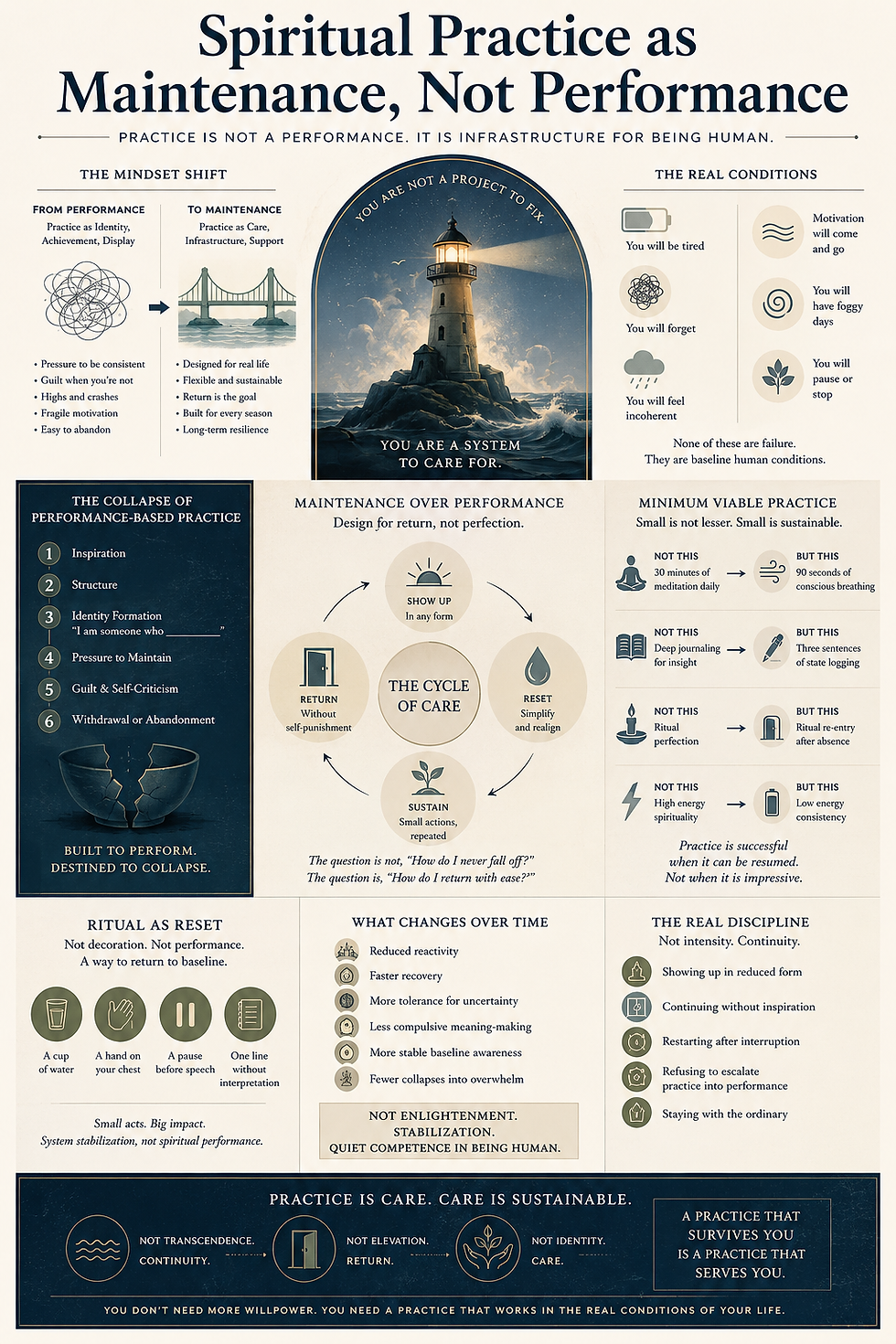
There is a quiet misunderstanding embedded in much of contemporary spiritual culture: that practice is something you do in order to become something else.
More peaceful. More aligned. More awakened. More consistent. More “high vibration.”
But under Saturn in Pisces, that framing begins to break down.
Not because spiritual practice is invalid—but because performance is too fragile a container for the kinds of internal realities people are actually living through.
What emerges instead is a more grounded and far less glamorous truth:
Spiritual practice is not performance. It is maintenance.
Not an identity.Not a display.Not a state of achievement.
Maintenance.
Practice as Infrastructure, Not Expression
Infrastructure is not visible when it works.
You don’t congratulate a building for having functioning plumbing. You don’t interpret electricity as a moral achievement. You don’t assume a bridge is “more evolved” because it is still standing after rain.
And yet many people relate to spiritual practice as if it must constantly prove itself through visible results.
Calmness that can be demonstrated.Insight that can be articulated.Awareness that can be sustained on demand.
When those conditions fail—as they inevitably do—people assume failure of the self.
But under a maintenance model, failure is not personal. It is informational.
It simply indicates that the system requires adjustment.
The Collapse of Performance-Based Spirituality
Performance-based practice tends to follow a predictable arc:
Inspiration
Structure
Identity formation (“I am someone who meditates / journals / aligns”)
Pressure to maintain consistency
Guilt when inconsistency appears
Withdrawal or abandonment of practice entirely
The problem is not discipline.
The problem is that the system was built to be performed, not sustained.
Performance requires energy surplus.Maintenance requires resilience under depletion.
Most human lives, especially over long periods of time, are not surplus states.
They are fluctuating systems.
Maintenance Is Designed for the Real Condition of Being Human
A maintenance model assumes:
you will be tired
you will forget
you will lose motivation
you will have emotionally incoherent days
you will not always “believe” in your practice
you will cycle through clarity and fog
you will sometimes stop entirely
None of these are errors.
They are baseline conditions.
The question is not:“How do I eliminate fluctuation?”
The question is:“How do I design a practice that survives fluctuation?”
Minimum Viable Practice
A maintenance system is not built on intensity. It is built on continuity.
This means replacing “ideal practice” with “minimum viable practice.”
Examples:
Not: 30 minutes of meditation dailyBut: 90 seconds of conscious breathing when overwhelmed
Not: deep journaling with insight extractionBut: three sentences of state logging (“what is present / what is needed / what is too much”)
Not: ritual perfectionBut: ritual re-entry after absence
The key principle is simple:
Practice is successful when it can be resumed. Not when it is impressive.
The Real Function of Ritual
In a maintenance model, ritual is not mystical decoration.
It is a reset mechanism.
A way of re-establishing baseline coherence when internal systems fragment.
Like rebooting a machine that has accumulated too many processes.
Ritual does not need to be elaborate to be effective.
It only needs to be repeatable under low capacity.
A cup of water. A pause before speech. A moment of hand-on-chest awareness. A single line written without interpretation.
These are not symbolic gestures of transcendence.
They are acts of system stabilization.
Consistency Is Not the Goal—Return Is
One of the most damaging myths in spiritual culture is the idea that consistency is the measure of success.
But consistency is a luxury of stable conditions.
Most real practice is not consistent.
It is cyclical.
The more accurate metric is:
Can you return without self-punishment?
Return after absence.Return after confusion.Return after doubt.Return after interruption.
The practice is not broken by stopping.
It is broken by the inability to resume.
Maintenance Without Identity Pressure
When practice becomes identity, it becomes fragile.
If “I am a meditator,” then not meditating becomes identity threat.
If “I am spiritually disciplined,” then exhaustion becomes moral failure.
If “I am aligned,” then emotional turbulence becomes personal collapse.
Maintenance removes identity from the equation.
You are not maintaining a “self-image.”
You are maintaining a system of care.
This reduces internal conflict and increases longevity.
What Actually Changes Over Time
Maintenance-based practice does not produce dramatic identity transformation.
It produces something subtler and more durable:
reduced reactivity over time
faster recovery after emotional disruption
increased tolerance for uncertainty
less compulsive meaning-making
more stable baseline awareness
fewer collapses into overwhelm
Not enlightenment as spectacle.
But stabilization of nervous and emotional systems over time.
Quiet competence in being human.
The Real Discipline
Under this model, discipline is not intensity.
It is:
showing up in reduced form
continuing without inspiration
restarting after interruption
refusing to escalate practice into performance
staying with the ordinary
This is a far less glamorous discipline than most spiritual narratives promise.
But it is the only one that survives real life.
Closing: Practice as Care System
If there is a single reframe worth keeping, it is this:
Spiritual practice is not something you perform to become someone better.
It is something you maintain so that you do not abandon yourself when conditions become unstable.
Not transcendence.
Continuity.
Not elevation.
Return.
Not identity.
Care.

Comments